Showing posts sorted by relevance for query tribeca. Sort by date Show all posts

Wednesday, May 10, 2006

Tribeca 3 -- Music


The Tribeca Film Festival has not just exploded past
its original geographic boundaries, but past its
original subject matter focus as well. In addition to
screenings of over 170 films and hundreds of
film-related events -- press conferences, receptions
for female and documentary film-makers, workshops,
demonstrations of new technologies, special one-on-one
sessions for first-time film-makers to get guidance
from the pros, and panel discussions with performers,
producers, and directors – there is an outdoor fair
for families, and there are scene readings featuring Matthew
Broderick and Judd Hirsh and art shows at a local
gallery.

Music in particular seems especially important this
year. Screenings include documentaries about
established and emerging music groups and the festival
will have live performances featuring Elvis Costello
and Allen Toussaint, John Mayer, and the Brazilian
Girls.

Musician/composer/soundtrack artist T. Bone Burnett
was interviewed by Vanity Fair’s Lisa Robinson before
a packed auditorium in a wide-ranging discussion
punctuated with clips from some of his films,
including “The Big Lebowski,” “Cold Mountain,” and “O
Brother Where Art Thou.”

Burnett talked about how he listens to music (loud and
on vinyl, and if anyone talks he turns it off) and the
way that “Music is not notes for me any more. It's
all booms and clumps and bumps and dings.
Onomatopoeia.” He talked about the original recording
of “I Walk the Line:” “Sam Phillips gave Johnny Cash
a dollar bill to stick under his guitar strings to
muffle the sound, turning his guitar into a snare
drum, just the heart beat of the song.” Burnett
coached non-singers Joaquin Phoenix and Reese
Witherspoon for their portrayals of Johnny Cash and
June Carter Cash.

Robinson asked how his relationship with the Coen
brothers began. “I went to see ‘Raising Arizona’ and
it hit me that these people had been paying attention
to all the things I had been paying attention to and
for the first time in my life I just called someone
up.” They told him they had a movie that, unlike what
they had done before, would have songs from artists,
not just a soundtrack, and they invited him to work
with them. It was The Big Lebowski.

“We had the Gypsy Kings do the Eagles song, ‘Hotel California.’ That's exactly the kind of misdirection with music that the Coens do visually.” He wanted to have Townes van Zandt perform the Rolling Stones song, “Dead Flowers.” Alan Klein, who manages the rights to the Stones songs, refused – until they showed him some scenes and he heard The Dude say the line, "I hate the Eagles." “So then he said, ‘All right, you can have it.’”

His new project is “Across the Universe,” inspired by the songs of the Beatles, directed by Julie Taymor of Broadway’s “The Lion King.”

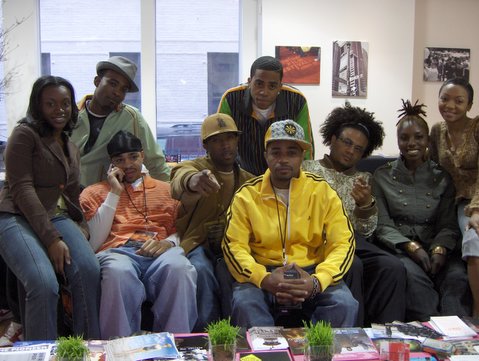
One of the emerging musical groups features in a
Tribeca films this year is “Word.Life: The Hip Hop
Project,” a documentary produced by Bruce Willis about
a program that teaches at-risk teenagers to tell their
stories through hip-hop. Chris “Kazi” Rolle, who
founded the program when he was a homeless teenager,
told me that he was inspired by “Hoop Dreams.” “A lot
of inner city kids see sports as their way out.”

Rolle wanted to give them a chance with something they
could do themselves, without relying on anyone outside
the community. So he adopted what he calls “the pill
in the dog food” approach, “pulling them in with what
they like,” hip-hop. His goal is to reach “the kid in
the back of the class – he is always scribbling
something.” When they arrive, they want to imitate
what they have heard. “Young people live from the
outside in; TV and radio tell them who they have to
be.” But he brings them back to the origins of
hip-hop – “it started as political” and encourages
them to tell their own stories by listening to them
and encouraging them to listen to each other.

Tuesday, April 25, 2006

Tribeca

I'm off to the Tribeca Film Festival early tomorrow and will be filing reports on Yahoo! Movies. This is Tribeca's fifth, but it is my first and I will try to see as much as I possibly can.

Wednesday, May 10, 2006

Tribeca, part 2

One of the sharpest and funniest films at the Tribeca
Film Festival this year has a young couple asking the
guy who is mugging them to pose for a picture. “Can
you hold the knife at his throat?” the woman chirps as
the mugger, well, mugs for her cell phone camera.
Then the couple wanders off to get some crepes, as she
says approvingly, “You really looked scared.”

It’s one of the shorts by American Express, the
sponsor of the festival, shown before the screenings,
and it exemplifies the cheerfully “fuggedaboutit”
attitude of a festival whose slogan is: “Even the city
that’s seen it all hasn’t seen this.” This is a
gathering for people who think of any situation, no
matter how dire, as a story to be told.

One issue that was raised in many contexts and venues
was the impact of new technologies on the world of
film-making. The
War Tapes
is one of the new category of
“Wiki-style” films. Documentarian Deborah Scranton
gave cameras to three soldiers in Iraq and let them
tell their own story. In a panel discussion, she
talked about getting the soldiers to trust her and
then editing their 800 hours of footage into a
feature-length film. “We were one degree closer than
an embed. We were able to see what it really means,
the immediacy of the experience, plus some perspective
by following them for 10 months after their return.”

Her fellow panelists compared the film to more
traditional forms of journalism and other kinds of war
coverage. Anthony Swofford, whose award-winning
memoir of his experiences in the Persian Gulf War was
the basis for last year’s Jarhead,
said that the soldiers did immediately what it took
him ten years to do: “For these soldiers, there is
very little distance between the event and receiving
the stark and real reality of what fighting is all
about. Stark and brutal images are less shocking to
us these days -- we have all seen headless and burned
bodies. What's more important to me is the narrative
of these guys trying to make meaning right away. One
concern with the lack of distance between the event
and communication is that we may be forgoing the 3-5
year period that it takes to achieve some
perspective.” One aspect that he found very accurate
was the “dark, dark, dark humor. That's what makes it
possible for these guys to get up every morning in the
midst of all the absurdity."

Time Magazine correspondent Aparisim Ghosh called this
format a “welcome addition.” While journalism
provides perspective and objectivity, and the war
changes so quickly that even if these three soldiers
returned they would find a very different story, the
immediacy of the moments in this film are very
significant and future historians will value this
unprecedented quantity of material.

Scranton said that it was Swofford’s book that
inspired her to want to help the soldiers tell their
stories. “It is one of the oldest stories in the
world, the hero's journey, like the Iliad and the
Odyssey. They go in our name and as a society we need
to know what it means to go to war and that's what I
wanted to show.”

Other challenges and opportunities for new technology
were raised in a session with Oscar-winner Morgan
Freeman, who concluded an interview about his career
with a discussion of his latest project, Click Star, an
entertainment and movie download service launching
this fall, with almost-immediate download of
theatrical releases, starting with Freeman’s “10 Items
or Less.” The service will include thematic,
genre-based channels to reflect the passions of star
performers, including an all-documentary channel run
by Danny DeVito. The service is in part a response to
the threats created by new technology. Their theme is
“We need to make movies easier to buy than to pirate.”
But Freeman and his partners see this as a great
opportunity to make non-studio films like the ones
featured at the Tribeca festival available to
everyone.

Tribeca, part 4


"Have you seen any comedies?" There was a wistful
tone in the voice of the man asking the question. He
was at Tribeca because he is a programmer for two
other festivals and he was looking for good prospects. He had no
trouble finding provocative, searing, troubling,
moving, and disturbing films on the schedule, but not
much luck finding comedies. While the people who buy
tickets like to laugh, the people who select festival
films tend to go for the earnest and sensitive over
the funny. As Woody Allen said, if you do comedy
you're always sitting at the children's table.

But with a little planning I was able to find some
great comedy moments at Tribeca. Jeff Garlin, who
plays Larry David's agent on HBO's "Curb Your
Enthusiasm,” adapted his one-man show into a romantic
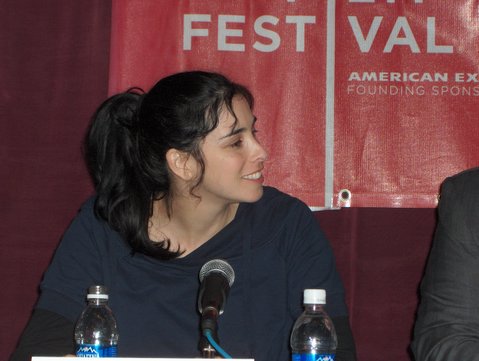
comedy co-starring Bonnie Hunt and Sara Silverman
called "I Want Someone to Eat Cheese With." Garlin,
who also directed, based the script on his own life.
The main character performs with Chicago's legendary
improv group, as did Garlin and Hunt in real life.
Silverman and Hunt play the women in his life, Chicago
actor David Pasquesi plays his best friend, and there
are marvelous cameos by Richard Kind, Dan
Castellaneta, and Amy Sedaris.

Garlin, Hunt, Silverman, and the producers spoke with
the press about the film, covering everything from
having to make up an outrageous but not descriptive
name for a sex act described in the film to their own
worst romantic experiences to the pleasures of
shooting in Chicago (Hunt called it "a big Mayberry"
and Garlin was proud to have made the first film to
feature Chicago's famous new "Bean" sculpture) to
Garlin's commitment to comedy that is not "quick,
convenient, or mean-spirited."

Garlin also appeared on a panel that saluted "Animal
House" and its influence on film comedies, along with
Harold Ramis (co-screenwriter), Todd Phillips ("Road
Trip," "Old School"), and Jake Kasdan ("Orange
County"), whose new satire of network television, "The
TV Set," starring David Duchovny and Sigourney Weaver,
was a popular festival selection.

Kasdan said that Ramis' "Stripes" and "Ghostbusters"
were his biggest influences. "'Stripes' is a perfect
comedy because it is about lazy, shlubby rebels who
are the coolest possible guys." He said the perfect
structure for a comedy is where "a nebbishy goofball
finds himself in the middle of some large structured
system and raises hell." “Low status is always
funny,” Garlin agreed.

Philips said it was the anti-establishment culture of
the Ramis films that attracted him. He said, "it was
brilliant to set 'Animal House' in the 1950's, when
the culture was one of respect for authority."
"Actually," Ramis explained, "the movie is set in
1963. It concludes with the parade in the fall and we
had it in our minds that it ended the day before JFK
was killed. No good comedy is set in the protest era.
‘M*A*S*H’ was set in an earlier war. Someone will be
funny about this war some day."

They also spoke about the value of improvising in
comedy. Ramis said, "The script was what we would do
if we couldn't think of anything better. Shooting was
the final draft of the script. There are techniques to
keep things fresh in drama. It doesn't depend on
surprise. But to be funny is almost invariably to be
surprising. It comes naturally and organically out of
some very specific moment that can never be repeated."
Phillips agreed, "The element of danger keeps comedy
alive. There is a fearlessness about great comic
actors like Will Ferrell. As a director I am the
opposite of a technician. I try to create a nice,
loose, environment to make the actors feel safe in
trying new things, not to be afraid something might
not work."

The younger directors acknowledged their debt to
Ramis, and he acknowledged his to those who went
before him. "We ripped off everyone. Everything we
did was derivative of someone else, silent films,
Ernie Kovacs, Martin and Lewis, Abbott and Costello.
We took from them and added some political
consciousness."

Sunday, April 30, 2006

First notes on Tribeca


My first dispatch from Tribeca is here at Yahoo! movies. More coming soon.

Saturday, February 17, 2007

Shrinks on Film (in both senses of the term)

The New Yorker has an
essay about the portrayal of psychotherapists in films. Or, an essay about the way psychotherapists think about the way they are portrayed in films.


Glen O. Gabbard, as they say, wrote the book. Gabbard, a psychoanalyst and a professor of psychiatry at Baylor College of Medicine, in Houston, is the author of Psychiatry and the Cinema, a study of Hollywood’s transference issues. Gabbard’s book offers a catalogue of pompous quacks (“Mr. Deeds Goes to Town”), swingers with Prince Valiant hairdos (“What’s New Pussycat?”), sadistic enforcers of social conformity (“One Flew Over the Cuckoo’s Nest”), love-starved lady doctors (“The Prince of Tides”), and serial killers who eat their patients (“Silence of the Lambs”)."


Gabard moderated a symposium on this subject at a recent conference, where the discussion focused on "The Treament," coming out this spring. I saw the film last year at the Tribeca Film Festival, and enjoyed it very much.
Rhona Engels, a psychotherapist, wondered why movies seem to offer three-dimensional portraits of patients but not of therapists. “I think it might have something to do with the power of what we do,” she said. “It can only be portrayed through projection—a kind of cutting down to size.”

Gabbard said simply, “If they ever showed an actual hour of therapy, it would be so boring that people would demand their money back.”

Afterward, Gabbard joined the panelists for dinner. At one point, someone suggested coming up with a list of movies that portray psychiatrists in a favorable light. Rudavsky named “Suddenly Last Summer,” in which Montgomery Clift plays a psychiatrist who saves Elizabeth Taylor from having a lobotomy. “Yes,” Gabbard said with a sigh. “That was from the golden age of psychiatry in the cinema.”

...


Gabbard’s own list included “Ordinary People,” but, he noted, “It’s the Hollywood version of therapy, which usually involves a dramatic, cathartic cure, brought about by a de-repressed memory of a traumatic childhood event, followed by tears and hugging.” He also cited the 1997 film “Good Will Hunting.” “It’s over the top, and the therapist uses methods that are unconventional and even outrageous,” he said. “But a naïve audience member could see it and come away with the impression that sometimes therapy actually helps people.”


I think the movies have done a better job portraying therapists than they have portraying mentally ill people, who are always either cute ("Benny and Joon," "King of Hearts"), less crazy than the "sane" people, or maniacal (horror/slasher movies of all kinds). In that same category of kind, caring, all-knowing psychotherapists who evoke great moments of breakthrough for their patients, I'd put Lee J. Cobb in "The Three Faces of Eve," Gregory Peck in "Dr. Newman, M.D.," and Ingrid Bergman in Hitchcock's "Spellbound."

Saturday, May 06, 2006

More from Tribeca

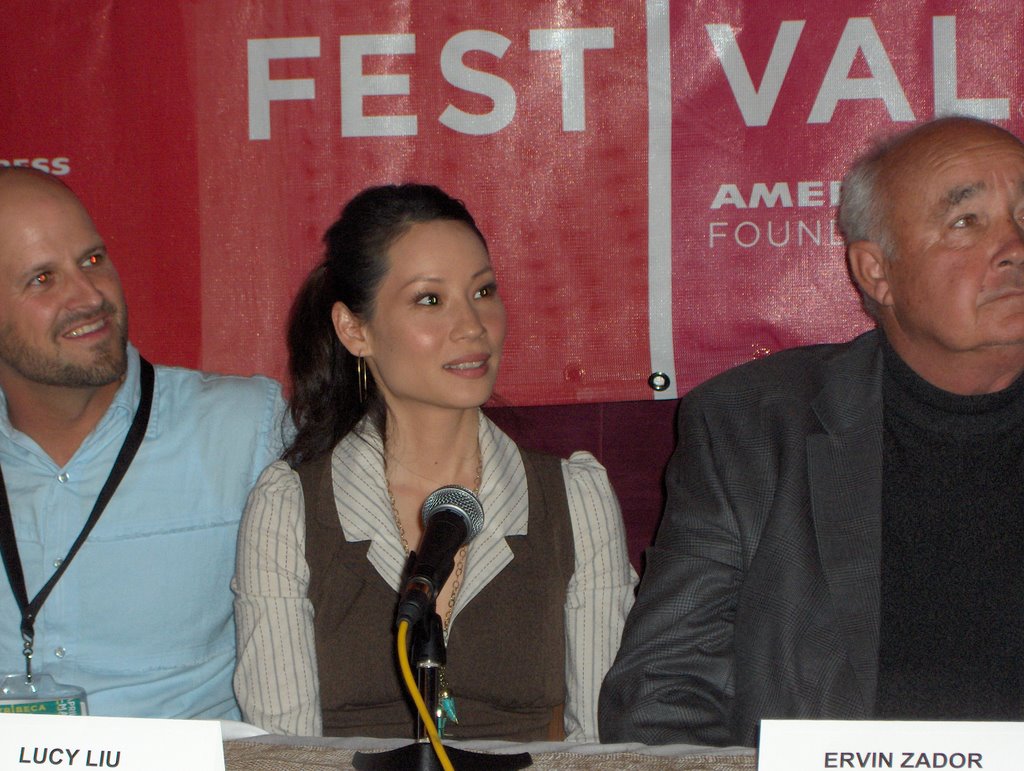
Lucy Liu spoke to the press about "Freedom's Fury," her new documentary about the 1956 Olympic water polo match betwen Hungary and the USSR.

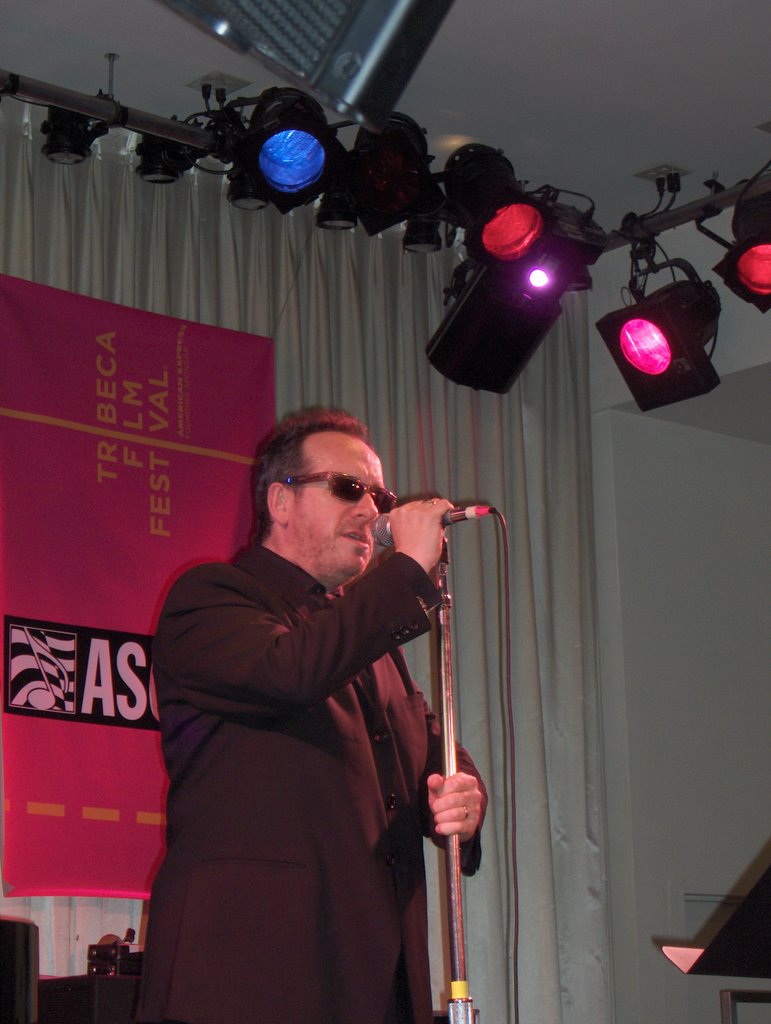
Elvis Costello performed with Alan Toussaint at the Saturn Lounge.

Saturday, April 29, 2006

David Junior interviews me at Tribeca

Here I am, talking to David Junior, just before the panel discussion on Jeff Garlin's charming new romantic comedy, "I Just Want Someone To Eat Cheese With."